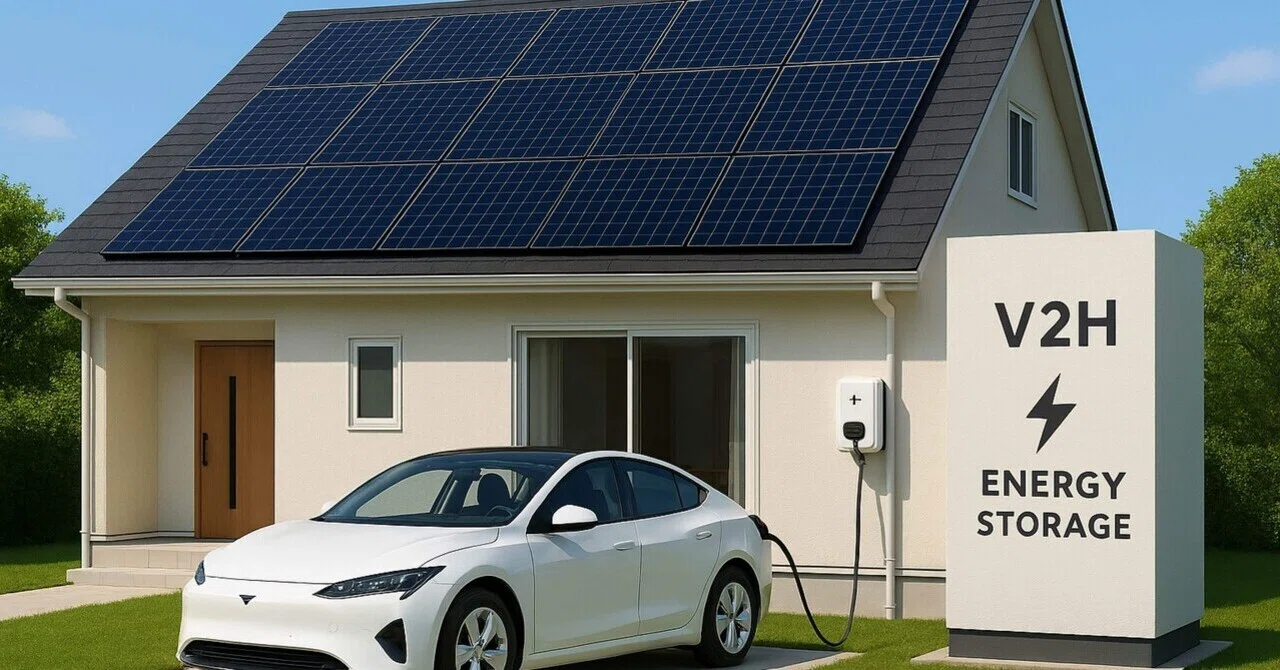
Episode 3‑3: The V2H × Tesla Powerwall Compatibility Test Finally Starts
In February, I officially began full‑scale testing of the Nichicon V2H system.
The three key points I set out to verify—introduced in the previous article—were:
- Can surplus solar power be used to charge the EV?
- Can the EV compensate for low solar generation on rainy days?
- How smoothly can the Tesla Powerwall and V2H operate together?
Here’s what I learned once I started testing in the real world.
—
1. Can Surplus Solar Power Charge the EV?
Using the Nichicon app, we set the system to operate in “surplus‑solar charging mode” only during the hours when excess generation typically begins.
- Charging start: 12:30
- Charging end: 15:30
The result—shown in Photo 1—was that the EV charged exactly as expected.
However, the charging efficiency was around 90%.
For example, even if surplus solar output was 3.2 kW, the EV actually received only about 2.9 kW.
Roughly 300 W of loss occurred during conversion.


Additional Findings from the Surplus‑Solar Charging Test
Nichicon does not officially publish charging‑efficiency figures, but in general the efficiency of V2H systems is said to fall within 85–92%.
My measured value of 90% was exactly within that expected range.
In other words, surplus solar power can be used to run the EV almost for free—without fossil fuels and without emitting CO₂.
It may be a small step, but it felt like a very real and meaningful one.
—
2. Can the EV Supplement Power on Low‑Generation Rainy or Snowy Days?
During the first weekend of February, we had snowfall, and several days of extremely low solar generation.
This was the perfect opportunity to test the opposite scenario:
How much of our household demand can be covered by discharging from the EV?
I set the system to discharge mode.
Once the Tesla Powerwall dropped to 20%, the EV began supplying power to the house.
(We keep 20% reserved as backup for outages.)
As shown in Photo 2, the EV started supplying power without any issues.
It was the first time my home had ever been powered by the EV.


Additional Challenges That Became Clear
As expected, a few challenges also surfaced:
- When household consumption drops below 1 kW, EV discharging becomes unstable
- The EV’s battery‑protection function may activate and stop discharging
These issues may be improved through adjustments on the Nichicon side, so I plan to continue testing this area.
If anyone has experienced similar challenges, I’d be glad to hear your advice in the comments.
—
3. A Clear Step Forward Toward 100% Self‑Consumption
- Surplus solar → EV charging
- Insufficient generation → EV discharging
Now that both directions are working, I’ve taken a significant step toward achieving 100% self‑consumption.
In the next articles, I’ll share the progress I am making on improving our home’s insulation to reduce overall energy demand.
コメント