What I Began Thinking as Electricity Prices Continued to Rise
Around 2023, I started wondering whether we could reduce our dependence on utility companies and generate as much electricity as possible at home. After nearly two years of comparisons, simulations, and cost evaluations, I finally decided to install a solar power system and home battery in February 2025.
What I Will Share Through This Blog
Goal: Achieving 100% Self-Consumption of Electricity
Using solar power and a home battery, I will document how close we can get to fully powering our home with self-generated electricity.
Future Theme: Electrifying Gas Appliances and Exploring Full Energy Independence
I plan to explore whether complete household energy independence is possible by electrifying gas-based systems such as the bath and floor heating.
A Small Hypothesis: How Would Communities Change if Homes Became Power Plants?
If individual homes generate electricity, store it, and use it as needed, could this contribute to greater grid stability across entire communities?
I will also examine this hypothesis as our real-world data accumulates.
Our Household Conditions
- Location: Kanagawa Prefecture, Japan
- Electricity purchased in 2024: 4,951 kWh
- Two-story detached home facing northeast
- Total floor area: 110 m² (60 m² on the 1st floor, 50 m² on the 2nd floor)
After about two years of research and planning, we installed the following equipment in February 2025:
- Solar panels: 6 kW
- Battery storage: 13.5 kWh (Tesla Powerwall 2)
Before installation, our estimates projected an annual generation of around 7,000 kWh and a self-consumption rate of 85–88%.
Upcoming Blog Episodes
Episode 2: 2025 — The First Year Our Home Became a “Power Plant”
- How we evaluated and selected our solar system
- Choosing battery capacity and understanding the costs
- Actual self-consumption results (February–December)
- Changes in electricity bills and cost-effectiveness
- How our daily life changed
- What becomes visible when a household shifts to the “supply side” of electricity
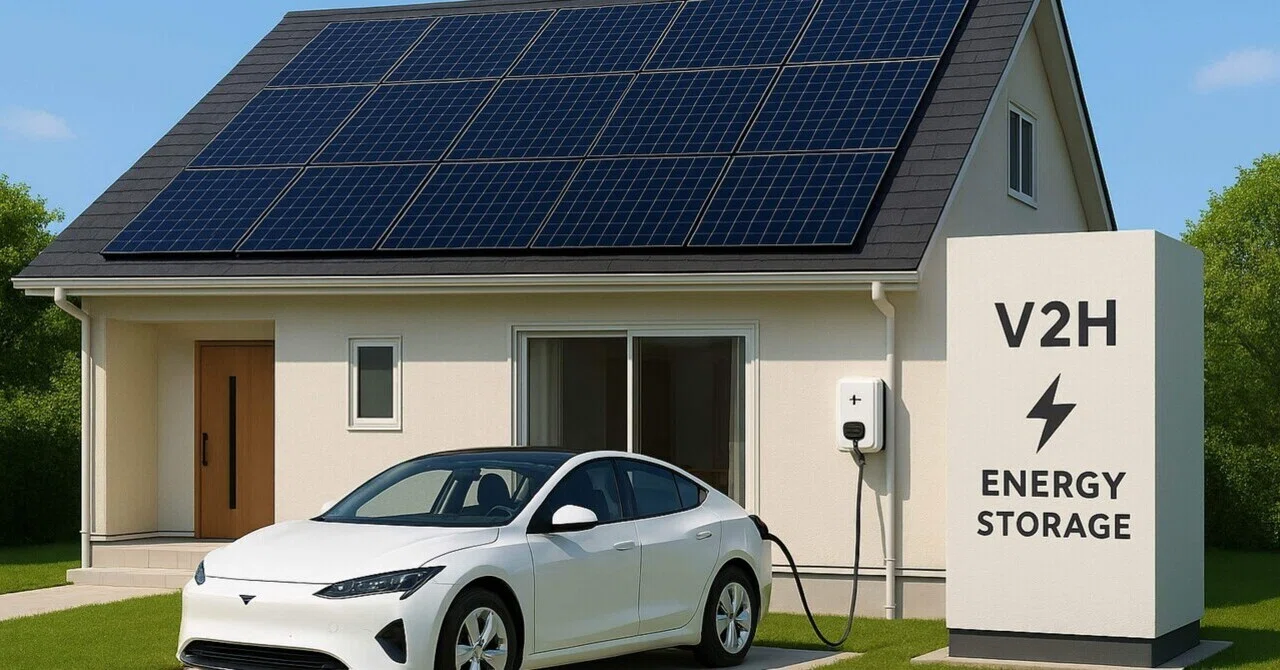
Episode 3: 2026 — Becoming a Home That Can “Send and Receive” Power with V2H
- Why we introduced V2H and how we selected the system
- What changes when an EV can charge and discharge
- The idea of a household becoming a “power buffer”
- Improved resilience during blackouts
- Contribution toward achieving 100% self-consumption
Episode 4: 2026 — Insulation Upgrades for a Home That Doesn’t Waste Electricity
Episode 5: 2027 — Full Electrification: Transitioning from Gas to an Integrated Electric Energy System
Episode 6: Summary and the Future — When Household Energy Connects to Society
This series will likely consist of around six episodes.
If there are topics you’d like me to explore or areas you want to know more about, feel free to leave a comment.
Starting next time, I’ll share the details of Episode 2.
コメント