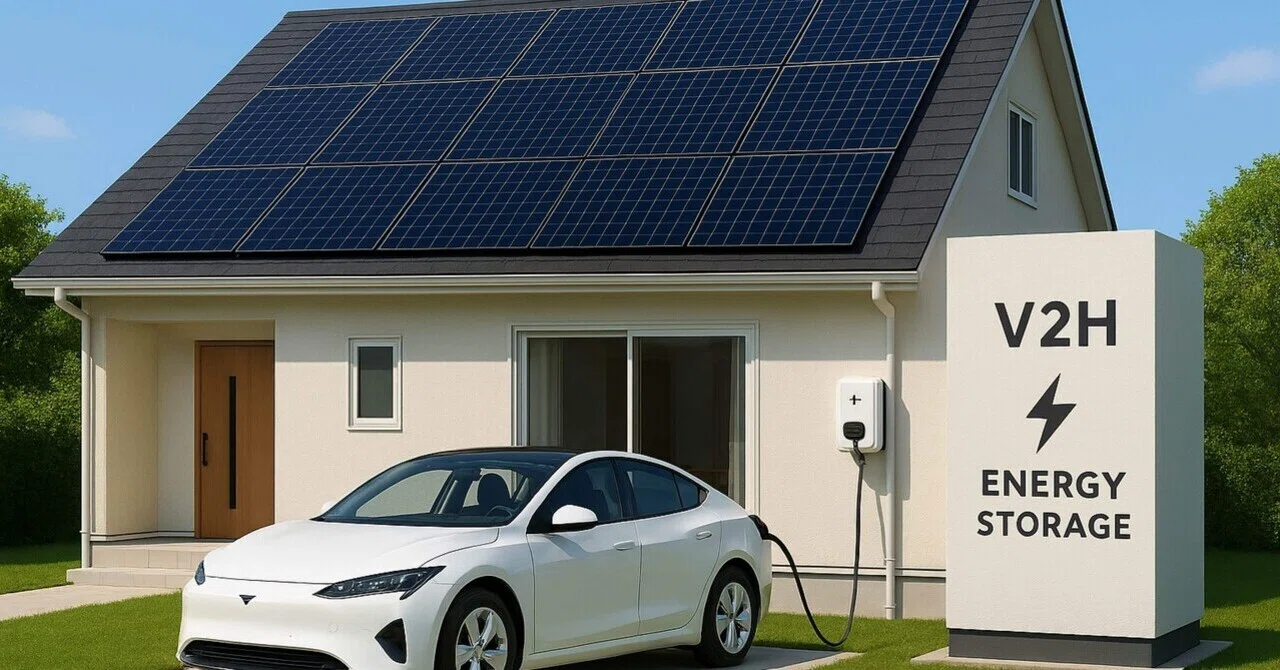
Episode 3−1: Giving Up on Adding More Home Batteries — and Deciding to Use my EV Battery as a “Second Home Battery”
To reach 100% self‑consumption, the key challenge is how to cover the hours when solar panels cannot generate power on rainy or cloudy days.
The simplest solution would be adding another home battery, but the cost didn’t make sense, and I didn’t have the physical space for it. I abandoned that idea early on.
—
Turning to the EV as a “Second Battery”
I had been driving a plug‑in hybrid for years, but the smoothness, quietness, and advanced feel of full EVs made me consider switching.
Fortunately, several conditions aligned:
- My previous car was popular and sold at a high price
- EV demand in Japan is low, so used EVs sell for about 60% off the new‑car price
- I could purchase one with minimal additional cost
And the biggest factor of all:
the EV battery capacity was about 90 kWh — seven times larger than my Tesla Powerwall.
Even in my highest‑consumption month (December), I purchased only 93.8 kWh from the grid.
On average, the EV battery alone could potentially cover my needs.
—
Moving Toward V2H: Facing Technical Barriers
With the idea of “using the EV battery as a home battery,” I began exploring V2H installation.
I initially considered a Nichicon V2H unit, which has a strong track record.
However, I discovered that it was not certified to work with the Tesla Powerwall, creating a compatibility issue.
This was the moment I realized how critical the layout and connection of these three systems are:
- V2H
- Tesla Powerwall
- Solar panels
I consulted two companies, and Company A stood out for conducting a thorough technical review.
Since last July, I have been working with them to finalize the specifications.
—
EV‑Side Limitations Also Became Clear
As discussions progressed, I learned that EVs themselves have operational constraints:
- If discharging below 1 kW continues for too long, the EV stops to protect the battery
- If the battery level becomes too low, discharging also stops
In other words, EV batteries are not designed for fine‑grained charge/discharge control.
Understanding how this characteristic aligns with household electricity demand became a key point.
—
Despite the Challenges, I Decided to Proceed
Although many issues surfaced during the V2H review, all technical concerns were resolved just before the end of last year.
And now, installation is officially scheduled for this month.
This marks the true beginning of our real‑world demonstration.
—
Next Episode Preview
In the next article, I’ll share the specific challenges I identified while preparing for V2H installation.
If you’re interested in using an EV battery as a “home battery,” I hope you’ll continue reading.
コメント